B2B appointment setting
B2B appointment setting is the process of getting a qualified decision-maker to agree to a specific meeting time with your sales team, usually through cold email, calls, or LinkedIn. It's narrower than full-cycle sales: the setter's only job is booking the meeting, not closing the deal.
We book 100 to 400 qualified appointments a year for B2B clients, with a 90%+ show-up rate, 30% higher than the agencies our clients switched from.
| Model | Cost per meeting | Best for |
|---|---|---|
| In-house SDR | $470-$1,040 | Proven volume, owning the process long term |
| Freelancer / VA | Highly variable, no real benchmark | Testing on a shoestring, accepting the quality risk |
| Outsourced agency | $150-$600, or $2K-$10K/mo retainer | Running this month, no hiring or tooling overhead |
So what is B2B appointment setting, actually?
B2B appointment setting is one job inside a bigger sales process: get a real decision-maker to agree to a specific meeting time. Nothing more. The setter doesn't pitch the product in depth, doesn't negotiate price, and doesn't close. They just get the invite accepted.
Some people confuse it with cold calling. Cold calling is a channel. Appointment setting is a job description, and these days it happens over email and LinkedIn at least as often as a phone actually rings.
Appointment setting vs full-cycle sales
Appointment setting owns exactly one step of that, getting step two onto the calendar.
Split the job and each half gets better at its half. That's the entire argument for a dedicated setter, or an agency, instead of asking your closer to also go find their own leads.
Full-cycle sales owns the whole relationship: , the demo, the objections, the contract, the renewal.
What B2B appointment setting actually costs
A fully loaded in-house SDR runs $9,800 to $14,200 a month before tools, producing roughly 10 to 14 meetings in that time. Do the math and that's $470 to $1,040 per meeting before a single deal closes.
| Model | Typical cost |
|---|---|
| In-house SDR, fully loaded | $9.8K-$14.2K/mo, ~$470-$1,040 per meeting |
| Outsourced, pay-per-meeting | $150-$600 per qualified meeting |
| Outsourced, retainer | $2K-$10K/mo |
That gap is why most companies under a certain size outsource this one job even when they keep the rest of sales in-house. We go through the full breakdown, including where a retainer beats pay-per-meeting, in .
Tips that actually book meetings
Precise targeting beats a clever script every time. A mediocre opener to the right person outperforms a great one to the wrong person, in every test we've ever run.
Five things move the number: a tight ICP, multichannel touches instead of one channel on repeat, real qualification before the invite goes out, a follow-up cadence nobody skips, and a clean handover to whoever closes.
The number nobody mentions: show rate
A booked meeting that no-shows is worth exactly nothing. The industry benchmark sits at 65% to 80%.
"They got us up and running quickly, and we started seeing some exciting wins within the first month. Grow Surely has significantly improved our ability to reliably reach our audience."

That gap between 65-80% and 90%+ isn't a nicer script. It's confirmations, reminders, and re-qualifying the invite closer to the date, treated as part of the job instead of an afterthought.
We go deep on each one, talk tracks included, in .
What we see running this ourselves
Real numbers from real accounts, not a composite average.
| Client | Meetings booked | Timeframe |
|---|---|---|
| batch (marketplace) | 134 meetings | 3 months |
| JARS Digital (SaaS demand gen) | 86 meetings | 9 months |
| Consultex PM (fractional CFO) | 76 meetings | ~12 months |
| Br8kthru (marketing consulting) | 74 qualified leads | 3 months |
| Venture Scaler (recruiting) | 64 meetings | 5 months |
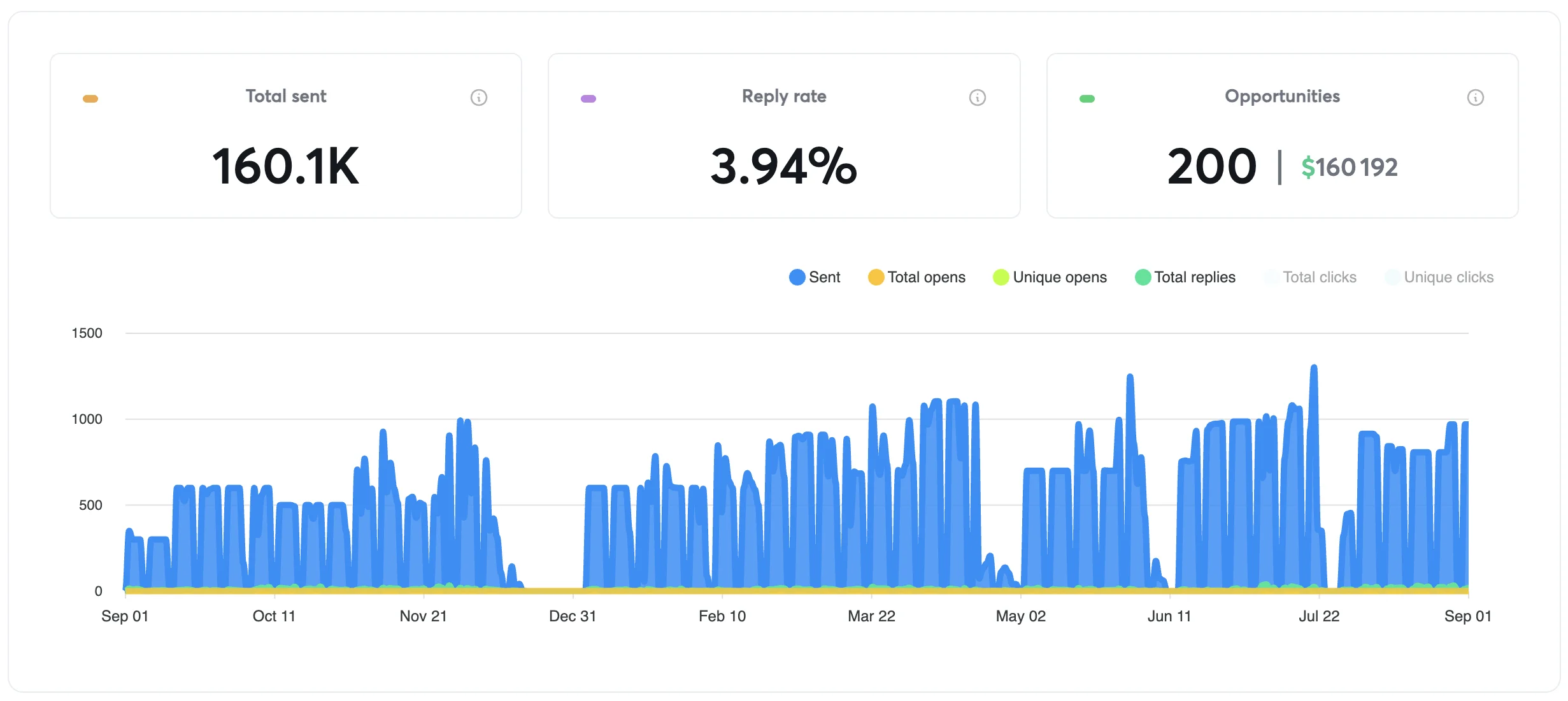
That account alone turned into $7.3M+ in qualified pipeline over six months, from the same 200 opportunities shown above.
In-house or outsourced: how to decide
I'd hire in-house once you already know the playbook works and want to own it for years. I'd outsource if you're still finding out whether outbound is even the right channel for your deal size.
| Choose this | When |
|---|---|
| In-house | Volume is proven, you want to own the process for years |
| Outsourced | You're still proving outbound works for your deal size |
Most companies get this backwards: they hire an SDR first, spend three months teaching them the ICP, and only then discover whether the whole approach was right. Prove it cheaply first, then build the team around what's already working.
What does a B2B appointment setter actually do?
They get a qualified decision-maker to accept a specific meeting time, usually over cold email, LinkedIn, or phone. They don't pitch the full product or close - that's the closer's job once the meeting happens.
How much does B2B appointment setting cost?
A fully loaded in-house SDR runs $9,800 to $14,200 a month, roughly $470 to $1,040 per meeting. Outsourced options run $150 to $600 per meeting, or $2,000 to $10,000 a month on retainer.
What's a good show rate for booked appointments?
65% to 80% is the industry benchmark. Below that, confirmations and reminders are usually the gap, not the pitch.
Is appointment setting the same as lead generation?
No. Lead generation surfaces a name and a maybe. Appointment setting goes further: a specific person agrees to a specific time. A lead is an idea, an appointment is a commitment.
Should appointment setting be in-house or outsourced?
In-house once volume is proven and you want to own it long term. Outsourced when you want it running this month without the hiring and tooling overhead first.
How is a qualified appointment different from just a meeting?
A meeting is a calendar invite. A qualified one already confirmed budget, authority, need, or timing before it was booked - which is why qualification rate matters more than raw meeting count.
Book real appointments, free.
Skip the trial and error - we build the list and run your first campaign for you. Real meetings booked in your first 7 days, so you see proof before you commit to anything.
Get my free meetings
P.S. If your last agency's idea of a "qualified" meeting was anyone who didn't hang up, what would a real qualification step actually catch?